

R&D Ergo new logo

ERGONOMIC SOLUTIONS FOR OVER 25 YEARS.

To serve you better | Now merging service and customer support with our sister company Liftsafe Engineering and Service Group.

Why Should You Choose Welding Positioners?

Welding Positioners help welders rotate and tilt workpieces into more accessible positions, rather than reaching every joint from an awkward angle. In a busy fabrication shop, that may mean bringing a circular flange to waist height, turning a frame steadily, and keeping the weld pool visible. Better access can support consistent bead placement, reduce unnecessary repositioning, and lessen strain during repetitive work. For example, a slow, steady turn can keep a long seam within comfortable reach, while a suitable fixture helps prevent small parts from shifting. These benefits are practical, not automatic. Setup matters.

Choosing a positioner means matching its capacity, rotation range, speed control, and fixture design to the work being produced. A compact unit may suit small components, while heavier assemblies need a properly rated table and stable clamping. Operators should check the workpiece’s weight and center of gravity, secure it correctly, and follow the manufacturer’s operating instructions. A positioner does not replace sound welding procedures or skilled judgment. It can, however, make repeatable positioning easier and improve access for inspection. Not every job needs one. For shops comparing equipment, the useful question is whether a positioner makes common welds safer, more consistent, and less tiring without disrupting the workflow. This guide explores those trade-offs, including productivity, weld quality, operator comfort, and the limitations buyers should consider before selecting a machine.
Why Should You Choose Welding Positioners?

What Is a Welding Positioner and How Does It Work?

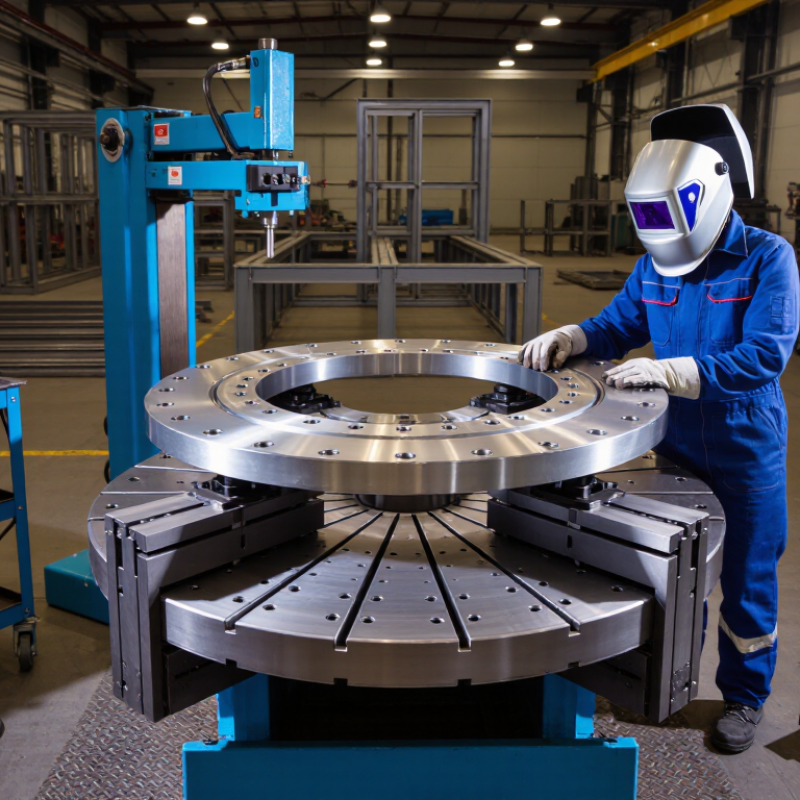
A welding positioner is a device that holds and moves a workpiece so a welder can reach the joint more comfortably. It usually has a rotating table, a base, a drive system, and controls for speed and direction. Some models also tilt the table, changing the joint angle as work progresses. The positioner does not weld; it moves the part. A simple example is a cylindrical tank section. Clamped securely, it can rotate the seam toward the welder instead of requiring the welder to move around the tank.

The operator places the workpiece on the table, secures it with suitable fixtures, and sets a safe rotation speed. Slow, steady movement can help maintain a consistent torch angle and travel position. That may reduce awkward reaching and make weld access more predictable, though it cannot guarantee weld quality. Fit and balance matter. An off-center load can cause vibration, while an unsuitable clamp may let the part shift. Stop the machine before adjusting fixtures, keep hands clear of moving parts, and follow the equipment’s rated capacity. It is not magic. A positioner can simplify access, but setup still takes judgment, and a rushed fixture check is an easy mistake to make.

How Do Positioners Improve Weld Quality and Consistency?

A welding positioner improves quality by keeping the joint steady and rotating it into a more workable orientation. AWS A3.0M/A3.0:2020 identifies four basic groove-welding positions: flat, horizontal, vertical, and overhead. A positioner can help operators keep more welds near the flat position, where torch angle, travel speed, and puddle control are easier to maintain. Small changes matter. A drifting arc or inconsistent travel can leave uneven bead width and penetration.

Consistency is easier to verify when the workpiece moves smoothly instead of the welder reaching around it. The operator can focus on a repeatable torch angle and maintain a steadier distance from the joint. That can reduce starts, awkward pauses, and uneven heat input across long seams. Track the results: compare rework per 100 joints, bead dimensions, and weld parameters before and after introducing a positioner. AWS’s Welding Handbook emphasizes controlling welding variables; the positioner supports that discipline, but it does not set the parameters for you.

It is not magic. Poor fit-up, incorrect settings, or a badly balanced load can still produce defects. A positioner also needs suitable speed and capacity for the part. One practical check is to record current, voltage, travel speed, and rework for the same joint design over several shifts. The data may be messy at first, but it can reveal whether improved access is translating into more consistent welds.

Why Should You Choose Welding Positioners? - How Do Positioners Improve Weld Quality and Consistency?

Welding factor Without a positioner How a positioner helps Quality or consistency benefit Practical consideration
Weld position The operator may need to weld in multiple positions, including overhead or vertical, depending on the joint and part orientation. Rotates or tilts the workpiece to make a more suitable welding position accessible. Can make it easier to maintain a steady torch angle and a consistent weld technique. The best position depends on the welding process, joint design, and approved welding procedure.
Access to the joint Restricted access can require awkward reach or repositioning around the workpiece. Brings different sides of the workpiece into a more accessible orientation. Improved access can help the operator follow the joint and maintain consistent torch positioning. Check clearances for the torch, cables, fixtures, and surrounding equipment throughout rotation.
Travel speed and bead formation Changes in posture or access may make a steady travel speed and bead profile harder to maintain. Allows the workpiece to be positioned for a more controlled, continuous welding pass where the joint permits. Can support more uniform bead appearance and more repeatable weld placement. A positioner does not set welding parameters; the operator or welding system must still control them.
Part repositioning Manual handling or repeated fixture adjustments may be needed to reach different welds. Provides controlled rotation or tilting without repeatedly removing the workpiece from its fixture. Keeping the setup stable can help reduce variation between weld locations and production cycles. Secure the workpiece correctly and stay within the positioner's rated load and center-of-gravity limits.
Operator posture Some welds may require prolonged reaching, bending, or working in a constrained position. Can help bring the joint closer to a more comfortable and visible working position. A more stable working posture may help the operator maintain attention and technique. Ergonomic improvement depends on workstation layout, part size, and how the equipment is used.
Repeatability Workpiece orientation may vary if each part is positioned or adjusted manually. Repeatable positioning and suitable fixtures can help present similar parts in a consistent orientation. Supports consistent weld access and setup from one part to the next. Repeatability also depends on fixture accuracy, part tolerances, operator practice, and process control.
Inspection and rework Difficult access can make it less convenient to inspect some welds during or after welding. Can orient weld areas for easier visual access and inspection. Improved access may help identify visible issues sooner and simplify inspection access. Use the inspection method and acceptance criteria specified for the application.

Note: A welding positioner supports workpiece handling and positioning; it does not by itself guarantee weld quality. Results also depend on the welding procedure, operator skill, joint preparation, equipment setup, and inspection.

What Safety and Ergonomic Benefits Do Positioners Provide?

Welding positioners can reduce the need to twist, kneel, or reach across a hot workpiece. Instead of walking around a large frame, an operator can rotate it into a more comfortable working position. That may help keep shoulders relaxed and the welding helmet at a steadier distance from the joint. Small changes matter. A heavy assembly held at waist height is often easier to work on than one requiring a crouched posture.

Positioners can also help keep hands away from awkward support points, but they introduce moving parts and pinch hazards. Secure the workpiece with suitable clamps, check the rated load, and keep clear while the table turns. Use guards and emergency stops where fitted, and follow the equipment’s operating instructions. A turned joint may improve access, yet it does not replace local fume extraction or other protective equipment. Honestly, setup still takes time, and poor clamping can make a positioner less safe than a fixed bench. Operators should inspect the setup before welding, especially when the part is irregular or off-center. A brief check can prevent a costly surprise.

Why Choose Welding Positioners?

Potential safety and ergonomic benefits

Positioners can rotate or tilt a workpiece to improve weld access and help reduce repeated manual repositioning and awkward reaching. The chart is a qualitative illustration, not measured performance data; results depend on the workpiece, equipment, and setup.

Which Industries and Welding Tasks Use Positioners?

Welding positioners are useful in fabrication shops, automotive production, shipyards, and energy equipment workshops. They rotate or tilt a workpiece so welders can reach joints from a more comfortable angle. This is especially helpful when building frames, tanks, pipe assemblies, and heavy equipment components. A steady, accessible workpiece can support consistent travel and reduce repeated repositioning.

Common tasks include circumferential welds on pipes and vessels, joining flanges, and welding seams on bulky frames. Positioners also help with repetitive parts, where the same joint must be presented at a similar angle each time. Smaller units suit compact assemblies; larger, rated machines handle heavier loads. Check load capacity and balance carefully. A positioner is not a cure for poor fit-up, a limitation that is easy to overlook. Operators still need suitable procedures, training, and inspection.

Tips: Secure the part before rotation, and confirm its weight is within the machine’s rating. Keep hands clear of pinch points. Test the movement slowly; awkward parts may shift more than expected.

How Do You Choose the Right Welding Positioner?

Why Should You Choose Welding Positioners?

How Do You Choose the Right Welding Positioner?

Start with the workpiece, not the machine’s headline capacity. Weigh the part together with its fixture, then consider how far its center of gravity sits from the rotation axis. An off-center load can demand more torque than its weight alone suggests. Check the table diameter, tilt range, rotation speed, and clearance for clamps, cables, and the torch. A positioner that turns smoothly with a bare part may struggle once a bulky fixture is installed.

Match the equipment to your actual welding cycle. For short runs, simple speed controls and quick setup may matter most; repetitive production may call for programmable motion and integration with other equipment. The International Federation of Robotics’ World Robotics 2024 report recorded 541,302 industrial robot installations worldwide in 2023. That figure is not specific to welding, but it makes future automation compatibility worth checking. Ask suppliers for rated load at different tilt angles, duty-cycle limits, and maintenance requirements. I would still test a representative part before committing; specifications rarely capture every awkward setup.

Tips: Bring your heaviest fixture and a sample part to the evaluation. Check for wobble, pinch points, and whether the operator can reach the seam without stretching. A slower, stable rotation is often better than impressive top speed.