

Why Choose Quartz Glass for Industrial Applications?
Industrial equipment often faces heat, chemical exposure, demanding cleanliness requirements, or changing light conditions. Quartz Glass can help meet these needs because it is made primarily from high-purity silica and offers strong thermal stability, low thermal expansion, and useful optical transmission. These properties make it a practical choice for components such as furnace tubes, sight windows, lamps, and laboratory processware. The details matter.
Its performance is not identical in every application. Grade, manufacturing method, dimensions, surface finish, and operating conditions can all affect service life. UV transmission, for example, depends on material purity and the wavelength involved. Quartz glass also resists many chemicals, but it is not immune to every substance or prolonged exposure. A poorly designed seal or sudden temperature change can cause problems, even when the material itself is suitable.
Choosing a material should start with the actual process: peak temperature, heating and cooling rates, chemical contact, optical needs, and cleaning practices. Engineers should also review supplier specifications and test parts under representative conditions where failure would be costly. This step is sometimes overlooked. Quartz Glass may offer clear advantages over ordinary glass or other materials, but it is not automatically the best option. Careful selection turns its properties into reliable industrial performance—and reveals where another material may serve better.
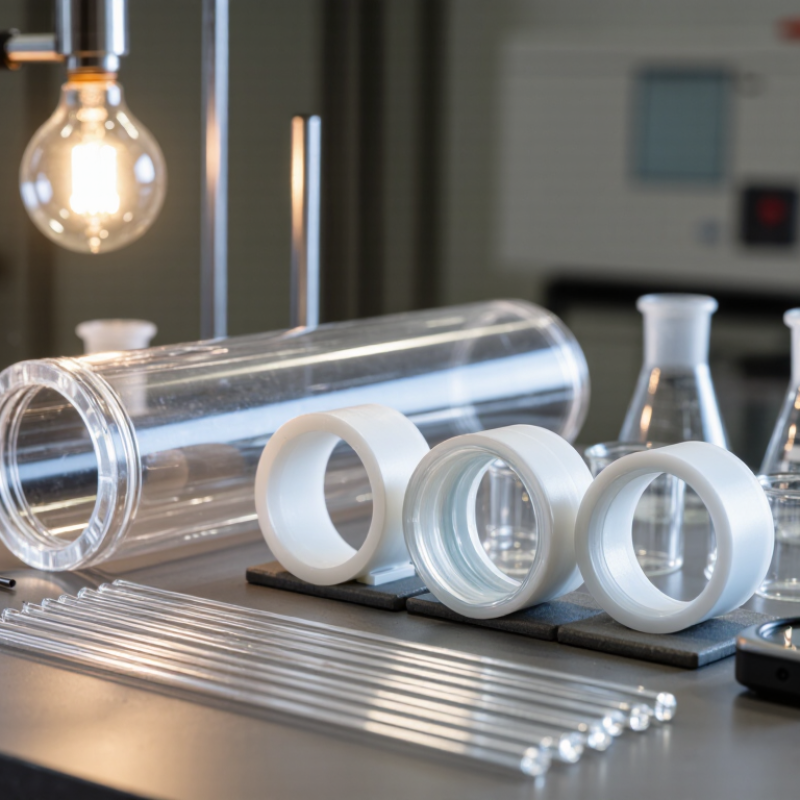
What Quartz Glass Is and How It Is Made
Quartz glass, also called fused silica, is glass made almost entirely from silicon dioxide. Unlike ordinary soda-lime glass, it contains very little added alkali or lime. Its structure is amorphous: the silica atoms lack the regular crystal pattern found in quartz. Not all sand qualifies. The U.S. Geological Survey’s Mineral Commodity Summaries 2024 estimated U.S. industrial sand and gravel output at about 120 million tons in 2023, but that broad supply is not automatically suitable for high-purity glass. Feedstock selection matters.
Manufacturers start with carefully selected natural quartz or purified silica. They melt it above roughly 1,700°C, then shape the viscous material into tubes, plates, or other forms. Electric fusion and flame fusion are common routes; the choice affects purity, dimensions, and production cost. As the glass cools, controlled annealing helps reduce internal stress. Small bubbles or trace metal contamination can still spoil a batch. The details are easy to underestimate.
The final material is valued for high-temperature stability, chemical resistance, and low thermal expansion. Those properties make it useful in furnace components, laboratory vessels, and semiconductor process equipment. In practice, “quartz glass” does not guarantee identical performance: manufacturing route, purity, and inspection standards all matter. A datasheet should identify these, rather than relying on the material name alone.
Key Properties That Support Industrial Performance
Quartz glass supports demanding industrial work through a combination of heat tolerance, chemical stability, and optical clarity. Its low thermal expansion helps components withstand rapid temperature changes with less risk of cracking. This is useful in furnace windows, process tubes, and laboratory equipment exposed to uneven heating. The exact performance still depends on part geometry and heating rate.
It also transmits ultraviolet and visible light, making it suitable for lamp envelopes, sensor covers, and inspection windows. High-purity quartz can reduce contamination in sensitive processes. Its electrical insulation properties are useful near high-voltage equipment, while its resistance to many acids supports contact with corrosive fluids. Not every chemical is harmless, though. Hydrofluoric acid and hot alkaline solutions can attack silica, so compatibility checks matter.
In practical installations, surface finish and mounting deserve attention. Scratches, edge damage, or uneven clamping can create weak points under thermal stress. A thick component may also respond differently from a thin tube. These details are easy to overlook. Quartz glass is not unbreakable, and its cost can exceed that of ordinary glass. For a real process, temperature cycles, chemical exposure, and cleaning methods should guide material selection.
Industrial Applications Across Different Sectors
Quartz glass serves different roles across semiconductor, solar, optical, and laboratory operations. In semiconductor plants, its low thermal expansion and high-purity surface suit furnace tubes, process chambers, and wafer-handling parts exposed to heat. SEMI reported that global semiconductor materials sales reached $67.5 billion in 2023. That figure describes the wider materials market, not quartz alone, but it reflects the scale of precision manufacturing where contamination control matters.
Solar manufacturing also uses quartz components in high-temperature processes, while optical systems rely on its light transmission and thermal stability. The International Energy Agency’s Renewables 2023 report said global renewable capacity additions approached 510 gigawatts in 2023, with solar photovoltaic providing about three-quarters. This growth is relevant to production demand, though it does not directly measure quartz use. In laboratories, clear quartz vessels and viewing windows help operators inspect reactions under heat or ultraviolet light. Useful, but not universal. Quartz can be brittle, and custom machining raises costs; engineers should check thermal cycling, chemical exposure, and replacement intervals before specifying it.
How to Select the Right Quartz Glass Grade
Why Choose Quartz Glass for Industrial Applications?
How to Select the Right Quartz Glass Grade
Choosing a quartz glass grade starts with the conditions it must withstand. Record the operating temperature, heating rate, wavelength range, and contact materials. These details often matter more than a broad label such as “high purity.” For example, a component near a hot zone may need low thermal expansion and controlled dimensions. An optical part may require specified transmission at its working wavelength. Small differences matter. Grade names and limits can vary between suppliers, so compare measured properties, not just product descriptions.
Check impurity levels, bubbles, inclusions, and hydroxyl content against the application’s tolerance. These features can affect optical behavior and performance during heating. Ask for the inspection method and the allowable variation across the part. Then review machining needs: a thin tube, a polished window, and a thick crucible face different risks. Test a representative sample under the actual heat cycle or process atmosphere when failure would be costly. I would not select a grade from a datasheet alone; real fixtures and temperature gradients can expose weaknesses that a simple specification misses. If requirements are still uncertain, document them before requesting a quotation.
Why Choose Quartz Glass for Industrial Applications?
Typical Thermal Expansion by Glass Type
Fused quartz has an exceptionally low coefficient of thermal expansion, helping components withstand rapid temperature changes with less risk of thermal stress. These are representative typical values; actual properties vary by composition, grade, and temperature. Select a quartz glass grade according to factors such as purity, hydroxyl content, UV transmission, and operating conditions.
Operating Limits and Maintenance Considerations
Quartz glass can tolerate intense heat, but its safe operating range depends on the grade, geometry, and exposure time. Check the supplier’s data before setting a process temperature. A thin tube and a thick sight window may respond differently, even in the same furnace. Rapid heating or cooling can create stress and cause cracking. Slow the temperature change where practical. Thermal shock is easy to underestimate.
Chemical resistance is also specific to the process. Some hot alkaline conditions can attack silica, while contamination may affect sensitive applications. Inspect surfaces for chips, scratches, haze, or deposits before use. Small flaws matter. Clean with compatible methods and soft, lint-free materials; abrasive pads can leave damage that is hard to spot. Avoid sudden contact with cold liquids when the glass is hot. Support components evenly, since clamping pressure can concentrate stress at an edge. Keep maintenance notes on temperature cycles, cleaning, and visible wear. It is tempting to treat clear glass as sound glass, but appearance alone cannot confirm its condition. Replace questionable parts according to the equipment specification, not guesswork.
Why Choose Quartz Glass for Industrial Applications? — Operating Limits and Maintenance Considerations
| Dimension | Typical Property or Operating Guidance | Industrial Relevance | Maintenance Considerations |
|---|---|---|---|
| Maximum service temperature | Many fused-silica components are used continuously at temperatures up to approximately 1,000–1,100 °C. The practical limit depends on component geometry, load, atmosphere, and exposure time. | Supports use in furnace viewports, thermal-processing equipment, and high-temperature process components. | Follow the component supplier’s temperature rating. Avoid prolonged exposure near the upper operating range, where deformation or surface devitrification may become more likely. |
| Characteristic glass temperatures | Approximate values for fused silica include a strain point near 1,120 °C, an annealing point near 1,210 °C, and a softening point near 1,665 °C. | These reference points help distinguish routine service conditions from temperatures associated with stress relief or substantial softening. | These are material reference values, not recommended operating set points. Do not use the softening point as a safe service limit. |
| Thermal expansion | Very low coefficient of thermal expansion: approximately 0.5 × 10⁻⁶ K−1 near room temperature. | Low expansion helps reduce dimensional change and thermal stress during temperature variation. | Low expansion does not make a component immune to thermal shock. Prevent localized heating, uneven cooling, and contact with cold liquids when the glass is hot. |
| Thermal shock resistance | Generally better than that of many common glasses because of its low thermal expansion; actual resistance depends on thickness, shape, surface condition, and temperature gradient. | Useful where equipment undergoes rapid temperature changes, provided the component is properly designed and installed. | Inspect for chips, scratches, and impact damage before thermal cycling. Heat and cool components gradually where process requirements allow. |
| Chemical resistance | Resistant to many acids and aqueous solutions, but attacked by hydrofluoric acid and strongly alkaline solutions. Hot phosphoric acid can also attack silica glass. | Suitable for many chemical-processing environments, but not universally corrosion-proof. | Check the chemical, concentration, temperature, and exposure time before use. Rinse compatible residues promptly and avoid unverified cleaning chemicals. |
| Optical transmission | Transmission depends on glass purity, grade, thickness, and wavelength. High-purity fused silica can transmit ultraviolet light more effectively than ordinary glass. | Can be selected for optical windows, lamps, and inspection ports where UV or visible-light transmission is required. | Confirm the specified wavelength range and transmission for the actual grade. Keep optical surfaces clean and avoid abrasive wiping that may scratch them. |
| Mechanical strength | Quartz glass is hard but brittle. Its practical strength is strongly affected by surface flaws, edge damage, loading, and component geometry. | Provides useful rigidity, but should not be treated as a ductile or impact-resistant material. | Use supports that distribute loads and avoid point pressure, bending loads, and impacts. Replace components with cracks or significant chips. |
| Devitrification risk | At elevated temperatures, surface crystallization can occur; the rate is influenced by temperature, time, and contamination. | Surface changes may reduce optical clarity and affect component performance in high-temperature service. | Keep surfaces clean, minimize unnecessary high-temperature dwell time, and avoid contaminant transfer from tools, furnace materials, or handling. |
| Routine cleaning | Cleaning methods should be compatible with the glass grade, surface finish, and any coatings or seals. | Proper cleaning helps preserve optical performance and limits contamination in sensitive processes. | Use clean, non-abrasive materials and compatible cleaning agents. Avoid sudden temperature changes during washing and drying. |
| Inspection and replacement | Service life depends on operating conditions, thermal cycling, chemical exposure, mechanical stress, and surface quality. | Regular checks can help identify degradation before it interrupts a process or compromises containment. | Inspect for cracks, chips, haze, deposits, and changes in fit. Replace damaged parts and follow the equipment’s documented inspection schedule. |
Note: Values are representative guidance for fused-silica or quartz glass and are not guaranteed specifications. Confirm the exact grade and component rating for the intended temperature, chemical environment, pressure, and optical requirements.

