

What Is Trichlor Pool Chemical Used For?
Trichlor Pool Chemical is a slow-dissolving chlorine sanitizer commonly used to maintain clean swimming-pool water. It is often sold as compact tablets, placed in a compatible feeder or floater according to product directions. As the tablets dissolve, they release available chlorine that helps control bacteria and other microorganisms. That steady release can be useful when a pool needs ongoing sanitation.
There is a trade-off. Trichlor also adds cyanuric acid, which helps protect chlorine from sunlight but can build up with repeated use. It is acidic, too, so regular use may lower pool pH and total alkalinity. A test kit can reveal changes before they become harder to manage. Check free chlorine, pH, and cyanuric acid, and follow the product label and pool-equipment instructions.
Small details matter. Keep tablets dry and separate from other pool chemicals; never mix products. Avoid placing them directly on pool surfaces, where concentrated chlorine may cause damage. Trichlor is not a substitute for testing, circulation, or proper maintenance. It may suit some pools better than others, depending on water balance and use. That part is easy to overlook. This guide explains what Trichlor Pool Chemical is used for, how it works, and which practical precautions help support safer, more consistent pool care.
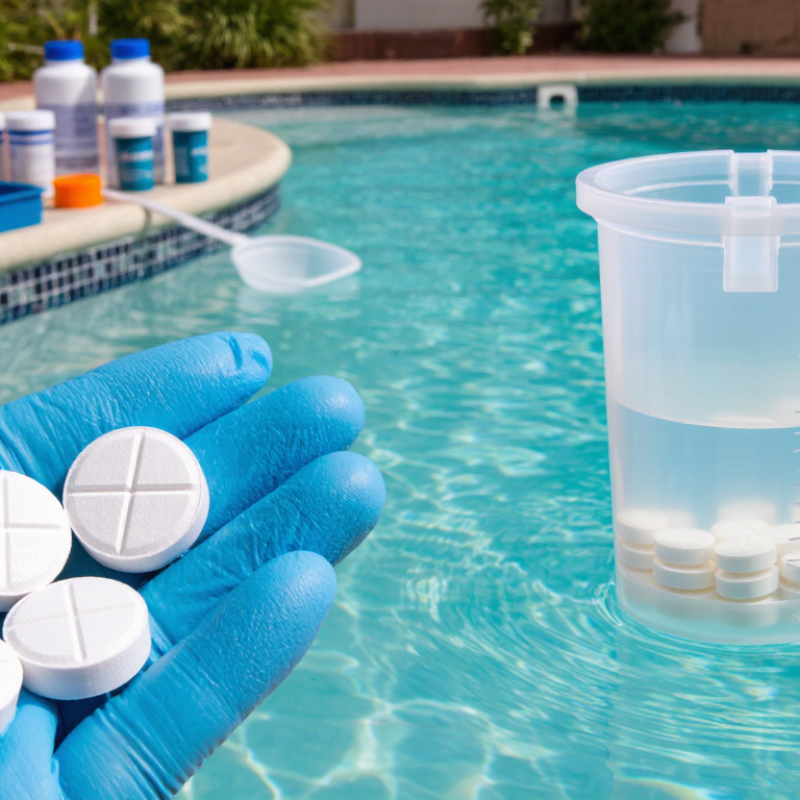
Trichlor at a Glance: Pool Tablets Typically Contain 90% Available Chlorine
Trichlor pool tablets are a slow-dissolving chlorine sanitizer used to help control bacteria and algae. Many pool tablets contain about 90% available chlorine, a measure of their potential disinfecting strength. It does not mean the tablet is 90% pure chlorine. Trichlor also contains stabilizer, which helps reduce chlorine loss from sunlight. A tablet slowly dissolves in a suitable feeder while water circulates. That steady release can be convenient. Still, it is tempting to treat one tablet as a fixed dose, but pool size, sunlight, heat, and swimmer load all affect chlorine demand.
Trichlor adds cyanuric acid to pool water over time, so regular testing matters. Too much stabilizer can make chlorine less effective, even when a test shows chlorine is present. Trichlor is also acidic and can lower pool pH. Check free chlorine, pH, and stabilizer with reliable tests, then follow the tablet label and equipment instructions. Use a compatible feeder, and avoid letting tablets rest against pool surfaces or equipment. Keep them dry. Never mix them with other pool chemicals; use clean, dry handling tools and store the container securely.
How Trichlor Disinfects Pool Water and Helps Control Algae
Trichlor is a stabilized chlorine compound used to sanitize pool water. As it dissolves, it releases chlorine that helps inactivate many disease-causing microorganisms. This keeps water safer for swimmers when free chlorine levels are maintained within the range recommended by pool-care guidance. The tablet dissolves slowly. That steady release can be useful in an automatic feeder.
Chlorine also helps control algae by disrupting its growth, but it is not a substitute for good circulation or routine cleaning. If water turns cloudy or green, check the free chlorine level, pH, and filtration rather than adding chemicals by guesswork. Brush slippery walls and steps, where algae can cling. It is easy to assume one tablet will fix everything. Often, it will not.
Trichlor adds cyanuric acid as it dissolves, which helps protect chlorine from sunlight. However, cyanuric acid can build up over time, so test it periodically and adjust pool care when needed. Trichlor is acidic and may gradually lower pH. Use it only as directed on its label, with suitable protective equipment, and never mix it with other pool chemicals. Keep the water moving. Check the readings again.
Why Trichlor’s Cyanuric Acid Stabilizes Chlorine Against Sunlight
What Is Trichlor Pool Chemical Used For?
Trichlor is a slow-dissolving chlorine sanitizer often used in outdoor pools. Its built-in cyanuric acid, or CYA, helps shield chlorine from sunlight’s ultraviolet rays. Without that protection, sunlight can break down free chlorine quickly, leaving less available to control microbes. CYA does not stop this loss entirely. It acts more like a temporary buffer, releasing chlorine as the active amount is used up.
There is a trade-off. As trichlor dissolves, it adds both chlorine and CYA; roughly 1 ppm of available chlorine adds 0.6 ppm of CYA. Over time, CYA can accumulate, while high levels reduce chlorine’s immediate disinfecting action. The CDC’s 2023 Model Aquatic Health Code sets 100 mg/L as an upper limit for CYA in pools using it. That is a ceiling, not a target. The World Health Organization’s Guidelines for Safe Recreational Water Environments also notes that CYA can affect chlorine disinfection. Test both free chlorine and CYA regularly, especially during hot, sunny weeks. A clear pool can still have an imbalance.
What Is Trichlor Pool Chemical Used For? — Why Trichlor’s Cyanuric Acid Stabilizes Chlorine Against Sunlight
| Aspect | Fact | What It Means for Pool Care |
|---|---|---|
| What trichlor is | Trichlor, or trichloroisocyanuric acid, is a solid chlorine sanitizer commonly sold as tablets or sticks. Its chemical formula is C3Cl3N3O3. | It provides a slow-dissolving source of chlorine for ongoing pool sanitation when used according to the product label. |
| Main pool use | As it dissolves, trichlor releases available chlorine that helps control bacteria and other microorganisms in pool water. | It is often used in an appropriate feeder or dispenser to maintain chlorine between water tests. Never place tablets directly in a skimmer unless the product label specifically allows it. |
| Sunlight and chlorine loss | Ultraviolet sunlight can break down free chlorine in outdoor pools. Trichlor also adds cyanuric acid (CYA), which reversibly binds some chlorine and reduces its rapid loss to sunlight. | CYA acts as a chlorine stabilizer, helping chlorine last longer outdoors. It does not create more chlorine, and it also reduces the proportion present as highly active, unbound chlorine. |
| CYA buildup | Each dose of trichlor adds both chlorine and CYA. As a practical approximation, adding 10 ppm of free chlorine from trichlor adds about 6 ppm of CYA. | Test CYA periodically. Because it accumulates, continued trichlor use can raise CYA over time; adjustment may require replacing some pool water, depending on test results and local guidance. |
| Available chlorine | Trichlor is a concentrated chlorine product, typically containing about 90% available chlorine by weight; exact specifications can vary by product. | Use the label’s directions and a reliable water-testing method rather than estimating dosage from tablet size alone. |
| Effect on pH | Trichlor is acidic and tends to lower pool-water pH as it dissolves. Its continued use can also contribute to declining total alkalinity. | Check pH and total alkalinity regularly and make water-balance adjustments based on test results. |
| Where it is most useful | Its built-in CYA makes trichlor particularly useful in many outdoor pools exposed to sunlight. | For indoor pools, or pools where CYA is already high, a non-stabilized chlorine source may be more suitable. Choose a treatment plan based on testing and applicable pool guidance. |
| Safe handling | Trichlor is a strong oxidizing chemical. It must be kept dry and stored separately from incompatible pool chemicals. | Never mix trichlor with other chlorine products, especially calcium hypochlorite. Follow the label, wear the recommended protective equipment, and keep chemicals away from children and pets. |
Using Trichlor Safely: CDC Advises at Least 1 ppm Free Chlorine, or 2 ppm with CYA
Trichlor is a stabilized chlorine chemical commonly sold as slow-dissolving tablets. It sanitizes pool water by releasing free chlorine, which helps control germs and algae. Trichlor also contains cyanuric acid (CYA), which slows chlorine loss in sunlight. That can be useful outdoors, but CYA can build up over time.
The CDC advises keeping free chlorine at least 1 ppm in pools, or at least 2 ppm when using CYA. Trichlor adds CYA, so the higher minimum matters. Check both chlorine and CYA with a reliable pool test kit; clear water alone does not confirm safe levels. Small details matter. If CYA rises too high, chlorine may become less effective, even when a test shows chlorine is present.
Tips: Follow the product label and use tablets only in equipment designed for them. Never mix trichlor with other pool chemicals, and avoid handling wet tablets with bare hands. Store them dry, in their original container, away from children and incompatible chemicals. Test regularly, especially after heavy rain or many swimmers. It is easy to assume one tablet solves everything; water testing is less convenient, but more dependable.
Trichlor’s Trade-Offs: Low pH and Gradually Rising Cyanuric Acid Levels
What Is Trichlor Pool Chemical Used For?
Trichlor is a slow-dissolving chlorine sanitizer, commonly used in tablets for feeders and floaters. Its trade-off is acidity: as it dissolves, it can lower pool pH and gradually reduce total alkalinity. The CDC’s 2023 Model Aquatic Health Code gives 7.0–7.8 as the recommended pH range for pool water. A small test strip reading near the lower edge is easy to overlook, but persistently low pH can irritate swimmers and contribute to corrosion or surface damage. Check pH and alkalinity regularly, especially when tablets are the main chlorine source.
There is another slow change. Trichlor adds cyanuric acid (CYA), which helps protect chlorine from sunlight but remains in the water as chlorine is used. A chemical mass-balance estimate is about 0.6 ppm of CYA for every 1 ppm of free chlorine supplied by trichlor. That rise may seem modest per dose. Over weeks, though, repeated additions can push CYA high enough to make chlorine less effective. The CDC’s Model Aquatic Health Code also sets a 100 ppm upper limit for CYA in pools. Track CYA alongside chlorine, and consider partial water replacement if levels keep climbing. I’d avoid relying on appearance alone; clear water can still have imbalanced chemistry.

