Top Insulated Floor Tile Panels for Global Buyers
Choosing the right Insulated Floor Tile Panels requires more than comparing prices or surface designs. Global buyers must examine thermal performance, structural strength, moisture resistance, and installation conditions. A panel used in a cold warehouse may not suit a humid hotel bathroom. Details matter.
This guide explores leading panel options for commercial, residential, and industrial projects. It considers core materials, tile compatibility, load ratings, dimensional stability, and available testing evidence. Experienced suppliers should provide technical datasheets, installation guidance, and clear information about insulation values. Buyers should also confirm product performance under local temperature changes, cleaning routines, and expected traffic.
There is no universal best panel. Not always. A lightweight design may simplify handling but reduce impact resistance. A thicker core can improve insulation while increasing floor height and shipping costs. These trade-offs deserve careful review before purchase. Product claims should be checked against recognized test methods and project requirements, rather than accepted at face value.
The recommendations in this article reflect practical sourcing concerns, including factory consistency, packaging quality, replacement support, and communication across borders. Sample testing remains valuable, especially when panels will support heavy furniture, equipment, or frequent foot traffic. Even a well-designed system can fail after poor substrate preparation or incorrect adhesive selection. That point is easy to overlook.
By comparing performance evidence with real installation needs, global buyers can make more reliable decisions. The aim is not simply to find attractive panels, but to select a durable, efficient, and properly documented flooring solution.
What Insulated Floor Tile Panels Are and How They Work
Insulated floor tile panels combine a rigid thermal core with a stable, tile-ready surface. The core commonly uses foam insulation, while the facing layer resists moisture and spreads loads across the floor. Together, these layers reduce heat loss through cold slabs, basements, and exterior-facing floors.
The working principle is simple. Insulation slows heat transfer. A tiled surface then distributes walking loads and protects the panel from daily wear. When installed above a cold concrete slab, the system can make the floor feel less harsh underfoot. It may also improve the efficiency of underfloor heating by directing more heat upward. Performance depends on the panel’s thermal resistance, thickness, joint design, and installation quality.
Small details matter. Panels need a clean, level base, with seams fitted tightly and supported correctly. A visible gap can become a thermal bridge. Moisture control matters too, especially in bathrooms, utility rooms, and ground-level spaces. Sealants, membranes, and tile adhesives must suit the panel material and local conditions. Always check load ratings and heating-system compatibility.
They are not magic.
A thick panel can still fail over a weak subfloor. A good product may perform poorly when rushed installation leaves movement beneath the tiles. One limitation deserves attention: added floor height can affect doors, steps, and transitions. I would measure these areas before ordering materials, rather than correcting them after the tiles are fixed. Reliable specifications should include compressive strength, water resistance, thermal values, and approved installation methods.
Key Materials and Structural Layers in Insulated Floor Tile Panels
Top Insulated Floor Tile Panels for Global Buyers
Key Materials and Structural Layers in Insulated Floor Tile Panels
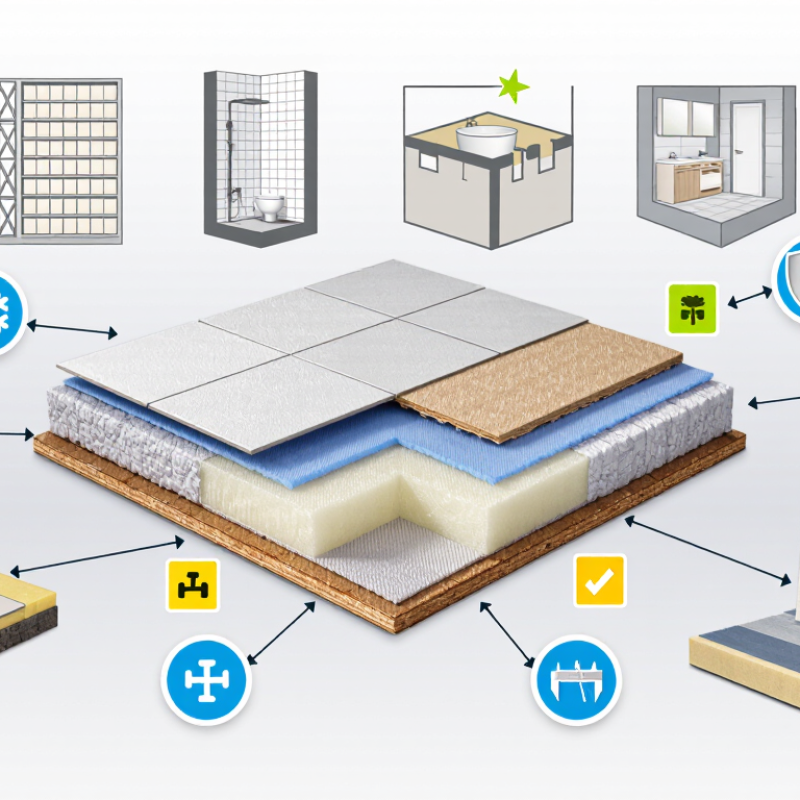
An insulated floor tile panel is a layered system, not merely a tile with foam underneath. The wearing surface is usually porcelain, ceramic, or another dense mineral finish. It resists abrasion, stains, and rolling loads. Beneath it, a cementitious setting layer spreads pressure across the panel.
The insulation core often uses XPS, PIR, or high-density EPS. Each material behaves differently. XPS handles moisture well, while PIR can provide strong thermal resistance at lower thicknesses. EPS may reduce cost, but its performance depends heavily on density and protection. A reinforced cement board or fiber-cement backing helps control bending. Some panels also include a vapor-control film. This small layer can prevent moisture from reaching the core. Gaps at panel joints can create thermal bridges.
During sample checks, I look closely at edges, joints, and cut sections. A clean edge suggests better manufacturing control. It does not guarantee field performance. Buyers should compare compressive strength, water absorption, thermal conductivity, tile bond, and fire classification. Test results should match the full assembly, not only one material.
No panel is perfect. A very rigid surface may crack if the substrate moves. Installation temperature, adhesive coverage, and floor flatness still matter. These details are easy to overlook.
Top Insulated Floor Tile Panels for Global Buyers
Typical structural layers and representative thicknesses used in insulated floor tile panel assemblies.
The illustrated assembly uses commonly specified building-material thicknesses: ceramic tile 8 mm, tile adhesive 5 mm, rigid XPS insulation 30 mm, cementitious structural board 12 mm, and a vapor-control layer of approximately 0.2 mm. Actual designs vary according to loading, moisture conditions, thermal requirements, and local building codes.
Main Types of Insulated Floor Tile Panels for Global Buyers
Insulated floor tile panels come in several main types, each suited to different project conditions. XPS-backed panels are common for bathrooms, balconies, and cold floors. Their closed-cell structure resists water and provides reliable thermal insulation. They are also lightweight and easy to cut on site. EPS-core panels usually cost less and offer simple handling. However, their lower density may require careful checking under heavy furniture or commercial traffic.
PIR and PUR panels provide strong insulation with relatively thin profiles. They can help preserve ceiling height during renovation work. Their performance depends on accurate joints and protected edges. Mineral wool panels offer better fire resistance and sound control, but they are heavier and may need stronger support. Some systems combine cement board surfaces with rigid foam cores. These panels create a stable base for ceramic or stone tiles when installed with compatible adhesives.
Global buyers should compare compressive strength, water absorption, fire classification, thermal conductivity, and panel thickness. Local building codes still matter. A product suitable for a dry bedroom may fail in a wet utility room. Check the substrate, drainage, and expected floor load before ordering. I have seen installation plans focus on insulation values while ignoring door clearances. That mistake can create expensive rework. No panel is ideal; performance depends on the whole floor assembly.
How to Evaluate Thermal, Moisture, and Load Performance
Top Insulated Floor Tile Panels for Global Buyers
How to Evaluate Thermal, Moisture, and Load Performance
Floor panels should be evaluated as a system, not by insulation value alone. The IEA’s Buildings 2023 report states that buildings consume about 30% of global final energy. Good floor insulation can reduce heat loss, but poor joints may weaken the result. Request tested thermal conductivity under ASTM C518 or ISO 8301 conditions. Compare declared R-values at the installed thickness, not only at laboratory thickness. Cold surfaces near doorways deserve extra attention.
Moisture testing is equally important. ASTM E96 measures water vapor transmission, while EN 12086 supports comparable vapor-resistance evaluation. Ask whether the panel resists ground moisture, cleaning water, and seasonal humidity. ASHRAE Handbook guidance commonly keeps indoor relative humidity near 30–60%, but real buildings often exceed this range. That gap matters. A waterproof tile surface does not guarantee a dry core.
Load performance needs clear numbers. EN 826 evaluates compressive behavior for thermal insulation products, while project codes may specify floor loads near 2.0 kN/m² for residential areas. Confirm point-load resistance under furniture legs, shelving, and wheeled equipment. Test the complete assembly, including tile, adhesive, joints, and substrate. Laboratory results can look reassuring. Installation errors still happen.
Tips: Request reports from accredited laboratories. Check test temperature and thickness. Inspect edge sealing and panel flatness. Ask for long-term creep data. I would also test one sample on site; small defects can become expensive surprises.
Installation Standards, Sourcing Factors, and Buyer Considerations
Choosing insulated floor tile panels for international projects requires more than comparing thickness and price. Installation standards should guide every specification. Confirm the required thermal resistance, fire performance, slip rating, moisture tolerance, and load capacity. Local building codes may differ, so request current test reports from accredited laboratories. The supporting floor must be clean, dry, level, and structurally sound. Even a small uneven area can create hollow spots or cracked joints.
Sourcing decisions also affect installation reliability. Check panel dimensions, edge profiles, density, packaging strength, and replacement availability before placing a large order. Ask for production tolerances and batch consistency. A low quotation may hide expensive freight, damaged corners, or unsuitable adhesives. I have seen projects delayed because the selected adhesive reacted poorly with the insulation layer. That mistake was preventable, but product data was not reviewed carefully.
Tips
Request a physical sample before approval. Test its fit, cutting behavior, surface grip, and bond strength under realistic conditions. Compare shipping weight with container limits and confirm moisture protection during transit. Keep spare panels for future repairs. Also, do not rely on translated brochures alone; obtain installation drawings and technical declarations in clear language. A small trial area can reveal problems earlier. It may feel slower, yet skipping this step often creates greater cost and rework.