
R&D Ergo new logo

ERGONOMIC SOLUTIONS FOR OVER 25 YEARS.

To serve you better | Now merging service and customer support with our sister company Liftsafe Engineering and Service Group.

How to Choose the Right Drum Handling Equipment?

Choosing the right Drum Handling equipment begins with the real worksite, not a product catalogue. A 55-gallon steel drum may weigh more than 200 kilograms when filled. Its center of gravity can shift during movement. Wet floors, narrow aisles, and uneven thresholds increase the risk.

MHI’s 2024 Annual Industry Report identifies labor availability, safety, and operational efficiency as continuing material-handling priorities. NIOSH lifting-equation research also shows why repeated manual lifting can exceed safe ergonomic limits. The U.S. Bureau of Labor Statistics continues to list sprains and strains among common workplace injuries. These findings support a practical decision: reduce unnecessary lifting, pushing, and uncontrolled rolling whenever possible.

Dr. Thomas R. Waters, a leading NIOSH ergonomics researcher, stated, “The best way to prevent back injuries is to eliminate lifting.” That principle should guide every equipment comparison. A drum lifter, handler, tilter, crane attachment, or forklift accessory must match the drum’s material, size, weight, and handling frequency. Check rated capacity. Check the drum grip. Check the release mechanism.

A neat specification sheet can still mislead. That assumption fails when operators cannot see the load clearly. Consider the full route, not only the pickup point. A reliable choice should reduce force, limit pinch points, protect drum integrity, and fit existing procedures. This guide examines those details, while acknowledging one uncomfortable truth: the cheapest device may create the most expensive weakness.
How to Choose the Right Drum Handling Equipment?

Define the Load, Drum Type, and Handling Environment

How to Choose the Right Drum Handling Equipment?

Define the load, drum type, and handling environment before choosing equipment. A full 210-litre steel drum may weigh over 200 kilograms, depending on its contents. That weight changes the required lifting capacity, wheel design, braking system, and stability controls. Plastic drums can deform under pressure, while fibre drums may tear when clamped too tightly. Confirm the drum’s material, dimensions, centre of gravity, and filled weight from reliable supplier records.

The handling environment matters just as much. A smooth warehouse floor differs from a wet loading dock or uneven outdoor surface. Measure aisle width, ramp gradients, doorway height, and turning space. HSE reported 543,000 workers with work-related musculoskeletal disorders in Great Britain during 2023/24, causing 6.8 million lost working days. Manual movement remains expensive. OSHA guidance also stresses secure storage, stable loads, and clear travel paths. Those details should shape the equipment choice, not appearance or price alone.

Check the actual route.

A drum trolley may suit short, level movements. A powered lifter may be safer for repeated transfers or elevated positioning. Clamps must match the rim design and drum condition. One weak assumption can cause failure. In practice, teams sometimes select capacity for the drum alone, forgetting pallet weight, slope resistance, and sudden stops. A site trial with a loaded drum is imperfect, but it often reveals problems that a catalogue cannot.

Match Equipment Features to Lifting, Moving, and Positioning Tasks

Choosing drum handling equipment starts with the task, not appearance. A full drum may weigh hundreds of pounds, and its center of gravity can change during movement. For lifting, check rated capacity, grip design, drum compatibility, and load stability. A clamp that fits one rim may fail on another. Measure the container first. Good equipment also allows controlled release, preventing drops near racks or doorways. Keep hands clear. That detail matters.

For moving, compare casters, steering response, handle height, and turning radius. Smooth floors need different wheels than cracked concrete or loading thresholds. In a narrow aisle, a compact truck may outperform a stronger but wider model. Brakes should hold on the actual slope, not only in a catalog test. I have seen teams focus on lifting capacity and overlook route clearance. That mistake creates awkward pushes, damaged drums, and rushed corrections. Walk the route with an empty unit before choosing.

Positioning requires finer control. Look for tilt locks, rotation control, height adjustment, and stable placement at the destination. A powered system may reduce strain, yet it still needs trained operators, inspections, and clear visibility. Manual equipment can suit short travel, but repeated cycles may cause fatigue. Do not assume more features are always better. Test the equipment with the real drum, floor, doorway, and storage height. Sometimes the first choice feels right and proves inconvenient. Recheck the task.

How to Choose the Right Drum Handling Equipment?

Match equipment features to lifting, moving, and positioning tasks for standard 55-gallon drums.

Suitability score: 1 = limited fit, 5 = strong fit. Scores reflect common operating characteristics such as lifting capacity, maneuverability, and positioning control.

Compare Manual, Powered, and Automated Handling Options

Choosing drum handling equipment starts with the work, not the catalog. Manual drum trucks suit short moves, low volume, and level floors. They cost less and need little maintenance. However, operators must control pushing forces, turning space, and drum stability.

The U.S. Bureau of Labor Statistics reported 1,724 fatal work injuries in transportation and material-moving occupations during 2023.

That figure covers many tasks, but it shows why movement planning deserves attention.

Powered equipment helps when drums travel farther or weigh near the site’s safe handling limit. Electric lifters reduce repeated pushing and improve positioning near racks, scales, and pallets. They still require charging, inspections, and trained operators.

A powered unit is not automatically safer. Poor visibility or a tight aisle can create new risks.

The Liberty Mutual Workplace Safety Index identified overexertion involving outside sources as a leading cause of serious workplace injury costs, exceeding 12 billion dollars in its 2020 estimates.

Automated systems fit predictable routes, high throughput, and controlled storage layouts. MHI’s 2024 Annual Industry Report found that 55% of surveyed supply-chain professionals increased technology investment.

Automation can reduce touchpoints, but integration costs and unusual drum sizes may be underestimated. A practical trial with loaded drums, uneven floors, and emergency stops reveals more than a brochure.

The difficult part is admitting that a slower manual process may be the better choice for occasional work.

Evaluate load weight, travel distance, floor condition, operator reach, maintenance skills, and future volume before selecting the equipment.

Check Capacity, Safety Controls, Ergonomics, and Compliance

Choosing drum handling equipment starts with capacity, not appearance. Confirm the drum’s gross weight, dimensions, material, and center of gravity. A “500 kg” rating may assume smooth floors and centered loads. It may not cover tilted drums or uneven surfaces. Check the rated load at the actual lift height. NIOSH’s Revised Lifting Equation uses a 51-pound load constant only under ideal conditions, showing why real handling demands caution.

Safety controls should match the work area. Look for positive brakes, guarded pinch points, emergency stops, and controls that require intentional operation. OSHA’s powered industrial truck standard, 29 CFR 1910.178, requires operator training and equipment inspection where powered trucks are used. Daily checks should include wheels, forks, chains, clamps, and hydraulic leaks. Small defects become serious quickly. That part is often neglected.

Ergonomics matters as much as capacity. Handles should keep wrists neutral, controls should be reachable, and operators should avoid twisting while pushing or pulling. HSE reports that manual handling contributes to more than one-third of workplace injuries in the United Kingdom. Use mechanical assistance for repeated movement, even when one drum feels manageable. Compliance also requires documented risk assessments, maintenance records, and training under applicable local rules. A useful review question is simple: can a trained operator control a loaded drum safely when visibility, flooring, or balance is imperfect?

Evaluate Maintenance Needs, Total Cost, and Operational Fit

How to Choose the Right Drum Handling Equipment?

Evaluate Maintenance Needs, Total Cost, and Operational Fit

Drum handling equipment should match your daily workflow, not just its rated capacity. Check drum size, weight, surface condition, and movement frequency. A unit used near wash areas may need corrosion-resistant components. Inspect wheels, brakes, lifting points, and controls during scheduled maintenance. Small defects become expensive when they stop production. Keep spare wear parts available, especially for wheels, seals, and lifting mechanisms. Maintenance records also reveal repeated faults that specifications may hide.

Total cost includes more than the purchase price. Include installation, operator training, inspections, repairs, energy use, and possible downtime. A cheaper unit may require frequent adjustments or special tools. That can increase labor costs over several years. Ask suppliers for service intervals and realistic part availability. Request a written estimate. Then compare it with your current handling process. The result may challenge your first choice, and that is useful.

Tips: Measure aisle width before ordering. Test the equipment with a full drum. Check turning space, floor slopes, and storage height. Ask operators where strain occurs. Their feedback often exposes poor operational fit. Do not ignore cleaning time. A design that is difficult to clean may create maintenance problems later. No checklist is perfect. Recheck assumptions after a short trial period.

How to Choose the Right Drum Handling Equipment? - Evaluate Maintenance Needs, Total Cost, and Operational Fit

Equipment Type Typical Load Capacity Best Operational Fit Maintenance Needs Typical Purchase Cost (USD) Estimated Annual Maintenance Key Limitations Total-Cost Consideration
Manual Drum Dolly Up to 450 kg
1 standard drum
Short-distance movement on level, smooth floors; low-frequency handling. Inspect frame, welds, drum restraint, casters, and fasteners monthly; lubricate moving parts as required. $150–$600 $20–$80 Requires operator pushing or pulling; unsuitable for stairs, ramps, uneven floors, or frequent lifting. Lowest acquisition and service cost, but labor time may become significant at higher handling volumes.
Manual Drum Truck Up to 450 kg
1 standard drum
Tilting, transporting, and positioning drums in warehouses, workshops, and production areas. Check wheels, axle points, retaining chain, drum cradle, and hydraulic or mechanical components if fitted. $300–$1,200 $40–$150 Operator effort increases with heavier loads, long travel distances, and slopes. Affordable for intermittent use; assess ergonomic risks and labor requirements before selecting it for continuous operations.
Hydraulic Drum Lifter Up to 450 kg
1 drum
Raising drums onto pallets, dispensing stations, scales, or work surfaces without powered vehicles. Inspect hydraulic seals, pump operation, frame, forks or clamps, wheels, and load-retention components. $700–$2,500 $80–$250 Limited travel speed and lift height; requires suitable floor conditions and correct drum engagement. Higher initial cost than a dolly, but can reduce manual lifting and improve positioning efficiency.
Powered Drum Stacker Typically 250–450 kg
1 drum
Frequent lifting and stacking in warehouses, production lines, and storage areas with moderate throughput. Battery charging, battery inspection, brakes, drive wheels, hydraulic system, controls, and safety devices require scheduled checks. $3,000–$10,000 $250–$800 Needs charging access, operator training, adequate aisle width, and planned battery replacement. Labor savings can justify the investment where drum movements are frequent or lifting height is required.
Electric Drum Rotator Typically 250–450 kg
1 drum
Controlled pouring, mixing, or content transfer where drum rotation and positioning are required. Inspect clamps, rotation gearbox, electrical controls, battery, brakes, hydraulic parts, and emergency-stop functions. $5,000–$15,000 $400–$1,200 Higher complexity; requires compatible drum dimensions, secure clamping, and trained operators. Useful when controlled dispensing reduces spills, waste, or repetitive manual handling; over-specification raises capital cost.
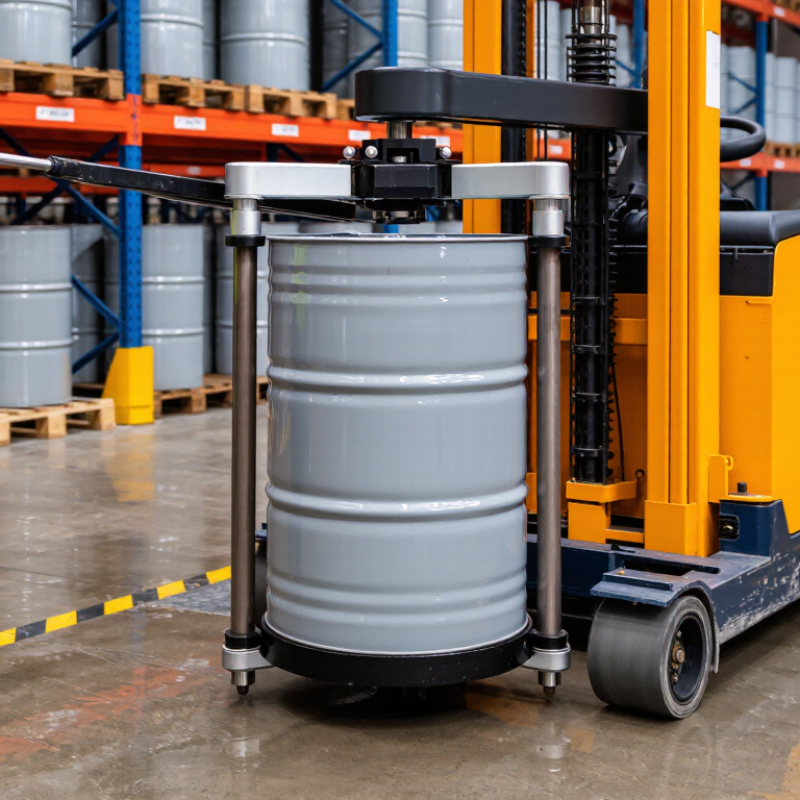
Forklift Drum Attachment Commonly 1–4 drums
per load
High-volume movement across larger sites where a compatible forklift and trained operators are already available. Inspect clamps, locking mechanisms, attachment points, load center, welds, and identification markings before use. $1,000–$5,000
attachment only
$100–$400
attachment only
Requires a suitable forklift, increased load-center awareness, trained operators, and wider aisles. Attractive when existing forklift capacity is available; include fuel or charging, inspections, training, and attachment compatibility.
Automated Guided Drum Carrier Typically 1–2 drums
per mission
Repeatable, high-volume routes between storage, production, filling, and dispatch areas. Requires preventive maintenance for batteries, drive systems, sensors, navigation hardware, software, safety scanners, and charging stations. $30,000–$100,000+ $2,000–$8,000 High integration effort; floor markings, route planning, safety validation, and process stability are essential. Best evaluated through labor reduction, utilization, throughput, and payback analysis rather than purchase price alone.
Planning Notes: The cost figures are indicative planning ranges in USD for new general-purpose equipment and exclude taxes, delivery, installation, customization, operator training, and facility modifications. Actual capacity depends on drum material, dimensions, contents, attachment configuration, load center, floor conditions, and applicable safety requirements. Annual maintenance estimates exclude major damage, battery replacement, and unscheduled repairs.