

China Top 10 Fixed Guards Fence Manufacturers
China’s manufacturing sector offers a broad range of fixed machine-guarding solutions for factories, warehouses, and production lines. A fixed guards fence can help separate workers from moving equipment while keeping work areas visible and accessible. Yet product names alone reveal little. Panel dimensions, mesh openings, post strength, coating quality, and mounting details all affect how a system performs on site.
This guide introduces ten Chinese manufacturers for buyers researching fixed guards and related industrial fencing. It is not a certified ranking. Instead, it provides a starting point for comparing product ranges, customization options, export experience, and support. Look for clear technical drawings, material specifications, quality records, and relevant project references. Ask how the supplier handles measurements, replacement panels, and installation questions. Small details matter.
A polished catalogue is useful, but it cannot replace careful checks. Verify claims directly with each manufacturer, and assess whether the proposed design suits your machinery, layout, and operating conditions. Standards and site requirements can vary, so obtain qualified advice when needed. The right supplier should explain trade-offs plainly, including limits. That part is easy to overlook. Manufacturers differ in responsiveness and documentation, and a strong first impression may not tell the whole story. This overview aims to make shortlisting more practical, while leaving room for buyers to confirm the details that matter most.
What Fixed Guards Fences Are and Where They Are Used
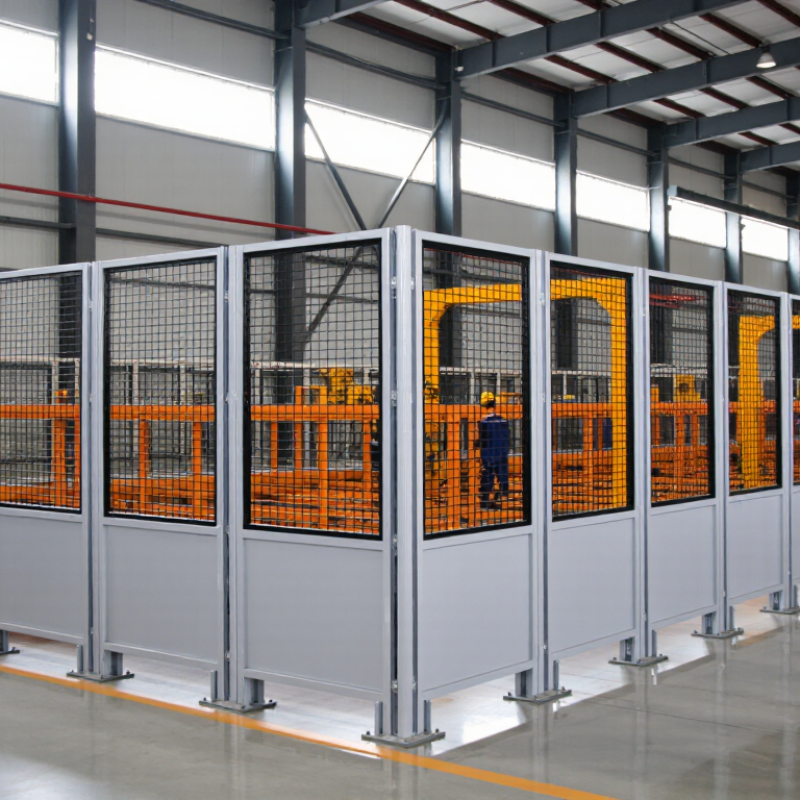
Fixed guards fences are rigid barriers used to separate people from moving machinery, stored materials, or restricted work zones. Their panels usually combine welded mesh or bars with posts and secure fittings. The open design keeps equipment visible while creating a clear physical boundary.
You may see them around automated production lines, robotic cells, warehouse conveyors, and maintenance areas. For example, a fence can keep a walkway apart from a forklift route, or shield workers from moving parts near a packing machine. Panel height, mesh spacing, and access gates should suit the actual hazards and the people using the area. A barrier that blocks sightlines can create new problems. Site layouts are rarely perfect, and awkward corners deserve a second look.
Tips: Measure the full perimeter before choosing panels. Check gate swing, floor condition, and nearby walkways. Leave access for cleaning and repairs. Ask a qualified safety professional to review the layout; a fence alone does not control every risk.
Common Applications of Fixed Machine Guards
Fixed guards are physical barriers commonly used to separate people from machine hazards when regular access during operation is not required. The chart is a qualitative application map, not a measure of market share or incident frequency. Guard design must suit the machine and the specific hazard; see OSHA 29 CFR 1910.212 for general machine-guarding requirements.
Common Designs, Materials, and Safety Requirements
Fixed guards create a physical barrier around moving equipment, and their design affects both access and visibility. Common options include welded wire mesh, perforated sheet, and solid panels. Mesh lets operators see through the enclosure and can support airflow, but its openings must be sized to prevent reaching hazardous areas. Perforated panels offer a more continuous barrier. Solid panels reduce exposure to debris, though they can hide equipment faults. Small details matter.
Materials often include painted or galvanized steel and stainless steel. The right choice depends on moisture, cleaning routines, impact risk, and the surrounding process. A coating may look durable but still chip at a cut edge. Check panel thickness, weld quality, fasteners, and anchoring points—not just appearance. A neat finish proves little on its own.
Safety requirements should follow a site-specific risk assessment and applicable local standards. Check that guards cannot be opened casually, have no sharp edges, and leave safe clearance from moving parts. Access doors may need interlocks where risk assessment requires them. Maintenance access matters too; a guard that is difficult to remove may be poorly refitted. When comparing manufacturers, request drawings, material specifications, inspection records, and clear installation guidance. I would not assume one standard design suits every machine.
China Top 10 Fixed Guards Fence Manufacturers - Common Designs, Materials, and Safety Requirements
A practical comparison of ten common fixed machine-guard fence designs. These are design categories, not named manufacturers. Final dimensions, openings, materials, and clearances should be selected through a machine-specific risk assessment and applicable local regulations.
| No. | Common design | Typical materials and construction | Typical applications | Key safety and selection considerations |
|---|---|---|---|---|
| 1 | Welded wire-mesh panels | Welded steel mesh in a steel or aluminium frame; commonly powder-coated or galvanized. | Robotic cells, conveyors, and production-line perimeters. | Mesh opening size and distance from the hazard must be assessed together to prevent reach-through. Secure panels against removal without tools where access is not intended. |
| 2 | Perforated-sheet panels | Punched steel sheet attached to a formed or welded metal frame. | Machinery requiring a more continuous screen than open mesh provides. | Check perforation size, panel strength, sharp edges, and visibility needs. Openings and mounting distances should follow the applicable safety-distance assessment. |
| 3 | Solid-sheet guards | Steel or aluminium sheet, often supported by a perimeter frame. | Areas needing separation from chips, splashes, or line-of-sight access to hazards. | Assess impact and containment requirements, panel fixing strength, and any gaps at joints or the floor. Solid panels can reduce visibility, so provide safe inspection access where needed. |
| 4 | Transparent-panel guards | Impact-rated polycarbonate or laminated safety glazing in a suitable frame. | Processes where operators need to observe machine operation while remaining outside the hazard zone. | Select material and thickness for the assessed impact, temperature, and chemical exposure. Inspect for cracking, clouding, and degraded fixings; transparent material does not replace adequate guarding. |
| 5 | Modular framed panels | Interconnected steel or aluminium posts and replaceable mesh, sheet, or transparent infill. | Production cells with changing layouts or multiple guarded sides. | Verify that joints, posts, and floor attachments remain stable under foreseeable loads. Any later layout change should trigger a review of access openings and safety distances. |
| 6 | Perimeter fence with fixed access panels | A fixed frame-and-panel enclosure with removable sections fastened by tools. | Large automated lines and machinery accessed mainly for planned maintenance. | Fixed sections should require a tool for removal and be secured against unintended detachment. If frequent access is necessary, assess whether a properly designed movable guard is more suitable. |
| 7 | Machine-mounted fixed guards | Formed or fabricated metal panels bolted directly to the machine structure. | Local guarding of belts, couplings, fans, and other transmission parts. | Prevent access to the danger zone while preserving necessary ventilation and serviceability. Fasteners should be secure, and guard removal for maintenance should be controlled. |
| 8 | Floor-mounted post-and-panel fence | Steel posts anchored to the floor with mesh, sheet, or transparent infill. | Independent work cells and machinery installed away from a building wall. | Check anchor suitability, floor condition, panel stability, and gaps at the base. The enclosure layout must prevent access over, under, or through the barrier where a hazard can be reached. |
| 9 | Corrosion-resistant fixed fence | Stainless-steel or suitably protected components selected for the environment. | Washdown areas, humid facilities, and environments with corrosive substances. | Specify materials and finishes for actual cleaning agents and exposure conditions. Corrosion protection should not compromise structural strength, fastener retention, or cleanability. |
| 10 | Fixed guard with controlled service access | Fixed panels combined with a separately designed access door where entry is required. | Enclosures requiring occasional operator or maintenance entry. | The fixed panels remain fixed guards; an access door is a movable guard and may require interlocking based on the risk assessment. Apply relevant guard and interlocking principles, including ISO 14120 and ISO 14119 where applicable. |
Standards note: ISO 14120 addresses the general requirements for the design and construction of guards; ISO 13857 addresses safety distances to prevent hazard zones being reached by upper and lower limbs; and ISO 14119 addresses interlocking devices associated with guards. Confirm the current editions and applicable national requirements for the machine and destination market. These references do not replace a machine-specific risk assessment.
How Fixed Guard Fences Are Manufactured in China
Fixed guard fences made in China typically begin with a site drawing, not a cutting machine. Engineers confirm panel height, post spacing, access points, and floor conditions. Small measurement errors can complicate installation later. Details matter.
Steel wire or tubing is cut to specified lengths, then positioned in jigs to keep panels square. Workers weld the joints and inspect for gaps, sharp edges, and uneven frames. The panels may receive galvanizing or a powder-coated finish, depending on the project’s corrosion and appearance requirements. Coating quality can vary if surface preparation is rushed, so it deserves close attention.
Before packing, manufacturers commonly check dimensions, finish, weld consistency, and fit between panels and posts. A sample assembly can reveal problems that drawings miss. For example, an anchor may conflict with a floor joint. That is worth catching early. Inspection records and clear packaging labels also help buyers track parts during delivery and installation. Still, no factory check fully replaces a site review; actual floors, clearances, and equipment layouts can differ from the plans.
Profiles of Ten Chinese Fixed Guard Fence Manufacturers
China’s fixed guard fence manufacturers often differ more in production focus than appearance. These ten profiles offer practical comparison points, not a verified ranking of named companies.
One profile specializes in welded mesh panels for warehouses. A second makes modular steel barriers for factories. A third focuses on galvanized finishes for outdoor use. The fourth offers powder-coated panels in varied colors. A fifth builds heavier guards for machinery areas. A sixth supplies standard panels for quick replacement. A seventh produces custom dimensions from site drawings. An eighth combines fences with gates and posts. A ninth emphasizes automated welding and repeatable spacing. The tenth handles smaller orders and mixed specifications. Details matter.
When assessing a supplier, request panel drawings, wire or tube dimensions, coating specifications, and a sample inspection record. Check that gate openings align with the intended layout, and ask how damaged sections can be replaced. Production photos can help, but they do not confirm finished quality. A site visit or third-party inspection may provide stronger evidence. Some suppliers may have limited documentation. That is worth noting, not ignoring. Compare lead times, packing methods, and responses to technical questions before deciding.
How to Compare Suppliers for Quality and Project Fit
When comparing fixed guard fence suppliers in China, start with jobsite conditions, not a catalog photo. Measure fence height, post spacing, panel length, and the clear width needed for gates. Ask for material grade, coating thickness, weld details, and documented inspection records. A sample panel can reveal sharp edges, uneven coating, or weak joints quickly. Small details matter. Confirm tolerance ranges and whether production samples are retained for later checks.
Then check whether the supplier can match your drawings and delivery sequence. Request a marked-up layout, installation notes, packaging dimensions, and a realistic production schedule. For outdoor sites, discuss drainage, corrosion exposure, and protection for cut edges. Compare quotations line by line; a low price may omit anchors, corner posts, or gate hardware. Ask how replacement parts are supplied and how defects are recorded. References help, but one project rarely proves consistent performance. I would still verify dimensions on a pilot section; drawings can miss site quirks. That takes time. Also confirm who handles measurement changes after approval.

