China Best Hydraulic Pile Driving Rig in Southeast Asia
Choosing China’s best Hydraulic Pile Driving Rig in Southeast Asia depends on more than price or advertised hammer force. Projects across the region face varied ground conditions, from soft coastal deposits to dense, weathered soils. A suitable rig must match the pile type, required installation depth, and available site access. It should also work reliably in heat, humidity, and heavy seasonal rain.
This article examines the practical features buyers should compare when evaluating a Hydraulic Pile Driving Rig in Southeast Asia. These include hydraulic output, operating stability, fuel use, transport dimensions, and compatibility with local pile sizes. Maintenance access matters too. A machine that is difficult to service can lose valuable working hours, even when its specifications look impressive. Not every site agrees.
Reliable selection also depends on evidence. Buyers can request technical documents, inspect manufacturing quality, and ask for references from comparable projects. Clear information about spare parts, operator training, and after-sales support helps reduce uncertainty. Still, a neat specification sheet can hide inconvenient details. Actual soil tests, site constraints, and the contractor’s experience should shape the final decision.
“Best” is therefore a project-specific judgment, not a universal label. A compact rig may suit a restricted urban site, while a larger model may better serve a high-volume foundation job. This guide offers a careful framework for comparing Chinese equipment and identifying what deserves closer verification before purchase.
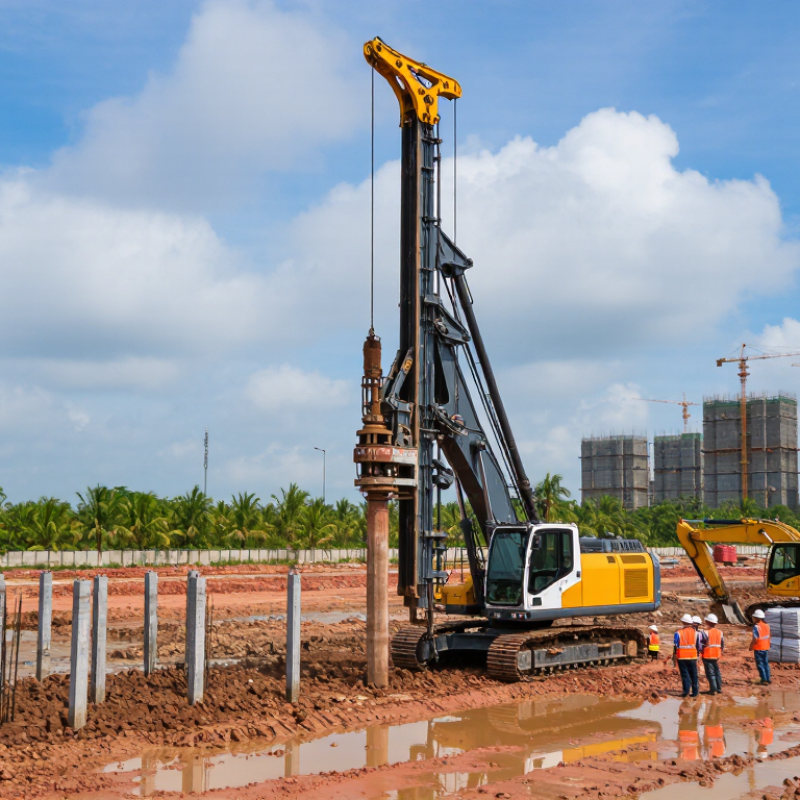
Hydraulic Pile Driving Rigs: Main Components and Operating Principles
A hydraulic pile driving rig combines a power unit, hydraulic circuit, leader, hammer, pile clamp, and supporting carrier. The engine drives hydraulic pumps, which send pressurized oil through control valves. Those valves regulate flow to the hammer and other working functions. The leader keeps the hammer aligned above the pile. Alignment matters.
During operation, hydraulic pressure moves a piston or ram inside the hammer. Its impact transfers energy through the pile and into the ground. The clamp or suitable driving attachment holds the pile steady, while the carrier supports the equipment on site. Operators watch gauges, listen for changes in hammer rhythm, and check that the pile remains close to vertical. Soil layers can vary over short distances, so driving response may change unexpectedly.
Good operation depends on more than impact force. Before work, crews should inspect hoses, connections, clamps, and the leader for leaks, looseness, or visible damage. They should also monitor oil temperature and follow the equipment’s operating limits. Small details count. In Southeast Asian conditions, heat, rain, and soft ground can complicate setup and maintenance. Even experienced operators may misjudge ground resistance; pausing to reassess alignment and driving behavior is often wiser than pushing through.
Comparing Impact Energy (kJ), Blow Rate (min⁻¹), and Hydraulic Power
China Best Hydraulic Pile Driving Rig in Southeast Asia
Comparing impact energy, blow rate, and hydraulic power requires more than reading three catalog figures. Impact energy, measured in kilojoules, indicates the hammer’s rated strike, not the energy reaching the pile. ASTM D4945 dynamic testing uses force and velocity measurements to assess transferred energy during driving. FHWA’s 2016 Design and Construction of Driven Pile Foundations manual also recommends wave-equation analysis to evaluate hammer performance, pile stress, and soil resistance. Useful data, not just a bigger number.
Blow rate, measured in min⁻¹, shows how often the hammer can strike. A high rate may help in some ground conditions, but it does not guarantee faster penetration; pile response, soil layers, and operating temperature matter. Hydraulic power depends on pressure and flow, while actual output also reflects system efficiency. Compare all three figures under stated operating conditions. Coastal Southeast Asian projects can shift from soft alluvium to dense layers over short distances. That complicates neat comparisons.
Tips: Check whether energy figures are rated or measured, and ask for test conditions. Match power and blow rate to the pile and expected ground profile. A one-number ranking can mislead; site data should guide the final choice.
Matching Rig Capacity to Southeast Asian Soils and Pile Types
Across Southeast Asia, ground conditions can change within a short drive. River deltas often hold soft alluvium, loose sand, or peat, while inland sites may expose dense sand and weathered rock. Choose a rig by the hardest verified layer, not average soil strength. That matters. For precast concrete piles, check hammer energy and leader capacity against pile length, section, and required penetration. Steel H-piles can pass variable strata, but still need controlled alignment and suitable handling capacity. Bored piles require different equipment and should not be treated as a driven-pile application.
Before mobilization, check hydraulic output, mast stiffness, clamp range, operating weight, and carrier stability. On saturated coastal ground, weak bearing capacity may limit the machine before hammer power does. In dense sand, excessive impact energy can damage pile heads without improving penetration. Record penetration per blow, rebound, verticality, and hydraulic pressure during trial installation. A tidy soil report can miss a buried soft-clay lens. It happens. Trial piles help confirm whether the rig can reach design depth without overstressing the pile. Access width and overhead clearance also matter; a powerful rig may not fit the site.
Verifying Pile Capacity with ASTM D4945 High-Strain Dynamic Testing
China Best Hydraulic Pile Driving Rig in Southeast Asia
Verifying Pile Capacity with ASTM D4945 High-Strain Dynamic Testing
A hydraulic pile driving rig can install piles efficiently, but installation records alone do not confirm capacity. ASTM D4945 high-strain dynamic testing measures pile response during a controlled impact. Strain and acceleration sensors near the pile head capture force and velocity signals. These measurements help engineers assess resistance and review pile integrity. Details matter.
In Southeast Asian projects, ground conditions can change over short distances, from soft coastal deposits to dense layers. Test piles should represent the installed piles and expected driving conditions. A prepared pile head and securely mounted, calibrated sensors help produce useful signals. Engineers interpret the results alongside soil data, installation records, and project requirements. The test provides an estimate, not a guarantee of performance under every service condition.
Tips: Keep sensor locations clear of loose concrete and check connections before each impact. Record hammer settings, pile dimensions, and the time of testing. Review signal quality before accepting capacity estimates; a tidy graph can still conceal poor setup. If results seem inconsistent, pause and investigate rather than relying on one number.
China Best Hydraulic Pile Driving Rig in Southeast Asia - Verifying Pile Capacity with ASTM D4945 High-Strain Dynamic Testing
| Assessment Dimension | Information Recorded or Evaluated | Relevance to Pile Capacity Verification |
| Test method | High-strain dynamic testing of a deep foundation element in accordance with the applicable ASTM D4945 procedure. | Provides a dynamic assessment of pile response during an impact; it is not a direct static load test. |
| Measured signals | Strain and acceleration signals are recorded near the pile head using securely attached transducers. | These signals are used to derive force and velocity histories during the impact event. |
| Applied impact | An impact device, commonly a suitable pile-driving hammer, delivers the blow required for the test. | The impact must generate interpretable signals and sufficient pile movement to mobilize resistance relevant to the assessment. |
| Force and velocity response | Force is derived from measured pile strain and pile properties; velocity is obtained from acceleration measurements. | Comparing force and velocity traces helps assess the pile’s response and identify data-quality or signal-matching concerns. |
| Mobilized resistance | Dynamic analysis estimates the resistance mobilized under the impact conditions, using the recorded response and appropriate analysis assumptions. | The result depends on the resistance actually mobilized during the test and should be interpreted in the context of the project criteria. |
| Driving stresses | Recorded force and pile properties can be used to evaluate stresses generated during impact. | Stress checks help assess whether the driving event may have subjected the pile to potentially damaging compression or tension. |
| Pile integrity indications | Changes or irregularities in the measured wave response may indicate a possible change in pile impedance or continuity. | Signal indications require engineering review and do not, by themselves, establish the location or cause of a defect. |
| Test setup information | Document pile dimensions, material properties, sensor locations, hammer details, and relevant installation and retest information. | Complete setup records support a traceable interpretation and help identify factors that can affect the measured response. |
| Report interpretation | Review signal quality, test conditions, analysis assumptions, and the stated limitations alongside the reported resistance. | Dynamic test results should be evaluated by qualified engineering personnel against the project’s design and acceptance requirements. |
Engineering note: High-strain dynamic testing estimates pile behavior and resistance under the test conditions. The result is not automatically equivalent to static ultimate capacity; interpretation depends on the data quality, pile response, mobilized resistance, and applicable project requirements.
Assessing Safety and Reliability Against EN 16228 Requirements
China Best Hydraulic Pile Driving Rig in Southeast Asia
Assessing Safety and Reliability Against EN 16228 Requirements
A pile-driving rig should be assessed against the applicable parts and edition of EN 16228, not a sales claim alone. The standard addresses safety for drilling and foundation equipment, but the relevant checks depend on the machine configuration. Review technical documents, risk assessments, and inspection records before work begins. Evidence matters.
On site, examine hydraulic hoses for abrasion, leaks, and loose fittings. Test emergency stops and verify that guards and access steps remain secure. Check the operating manual, load limits, and control labels. A wet, soft work platform can change stability quickly, especially during monsoon conditions. Small details matter.
Reliability also depends on maintenance and operator practice. Keep service records, investigate unusual vibration, and confirm that safety devices still function after repairs. Operators need clear procedures for setup, movement, and shutdown. A rig can pass a workshop inspection and still face risks on uneven ground. That gap is easy to underestimate. Local site conditions, competent supervision, and repeat inspections help turn documented requirements into safer daily work.