

What Are the Best Heat Exchanger Plates in 2026?
In 2026, choosing the best Heat Exchanger Plates is less about finding one universal winner and more about matching a plate design to real operating conditions. A plate that performs well in a clean-water system may struggle with viscous fluids, suspended solids, or frequent temperature swings. Small details matter: gasket compatibility, channel geometry, pressure drop, and access for cleaning can shape lifetime performance.
The International Energy Agency’s Energy Efficiency 2023 report estimates that industry accounts for roughly 37% of global final energy use. That figure makes heat recovery and efficient thermal transfer important considerations, but it does not prove that any single plate material or pattern is best. ASHRAE’s Handbook—HVAC Systems and Equipment also treats factors such as fouling, maintenance, and operating conditions as practical parts of heat-exchanger selection. Buyers should therefore compare verified performance data, not just catalogue claims.
This guide examines common plate materials, designs, and selection criteria for 2026 applications. It considers heat-transfer performance alongside corrosion resistance, service life, cleaning needs, and total operating cost. Not always an easy trade-off. Stainless steel may suit many duties, while titanium or other alloys can be more appropriate for demanding fluids; the right choice depends on the process and supplier specifications. Rankings can be useful, but they may hide assumptions about temperature, flow rate, and maintenance. The best choice is the one that fits the actual duty—and can be supported by credible technical data.
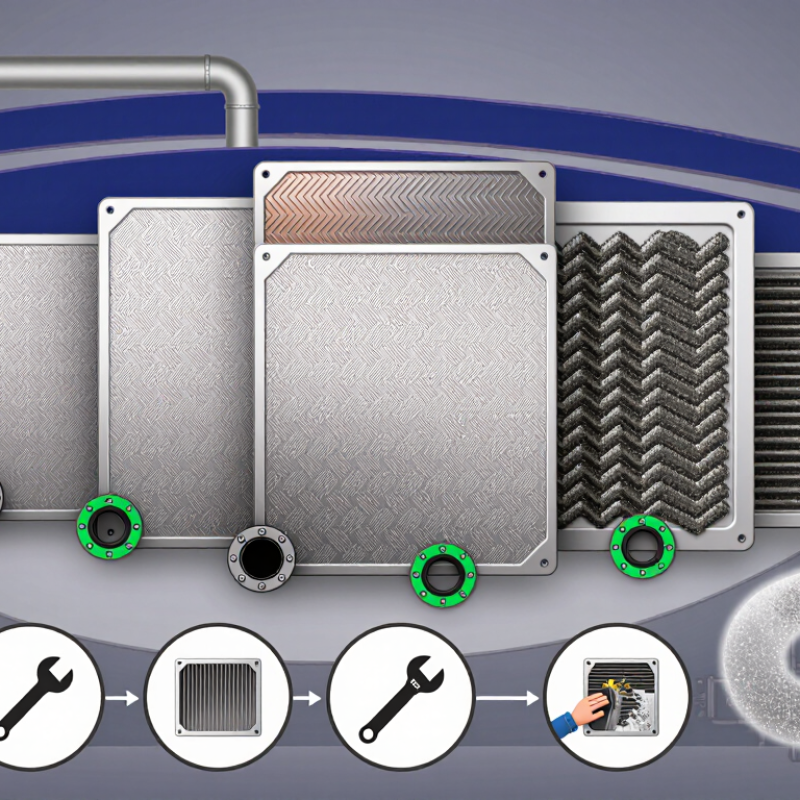
How Heat Exchanger Plates Transfer Heat Between Fluids
A plate heat exchanger moves heat through thin metal sheets without mixing the two fluids. Hot fluid flows through alternating channels, while cooler fluid passes through the channels beside them. Heat conducts through each plate, from the warmer stream to the cooler one. The fluids often travel in opposite directions, keeping a useful temperature difference across much of the exchanger. Corrugated plate surfaces also disturb the flow and improve heat transfer. Small channels matter.
The U.S. Department of Energy’s 2022 Industrial Decarbonization Roadmap reports that industry uses about 30% of U.S. energy. Recovering process heat can therefore matter, though a plate exchanger’s actual savings depend on the application. Engineers assess inlet temperatures, flow rates, fluid properties, pressure drop, and fouling risk before choosing a plate design. More turbulence can boost heat transfer, but it can also increase pumping demand. That trade-off is easy to overlook.
In a real installation, deposits can build up in narrow passages and reduce performance. Gasketed units allow access for cleaning; welded designs suit some demanding conditions but can be harder to service. There is no universal “best” plate for 2026. A sensible choice matches the required duty and maintenance plan, then checks performance against measured operating data. I would still question any selection based on peak efficiency alone.
Which Plate Designs and Materials Are Available in 2026?
In 2026, heat exchanger plates are available in several patterns, each suited to different flow conditions. Chevron, or herringbone, plates use angled channels to balance heat transfer and pressure drop. A steeper pattern can increase turbulence, but it may also require more pumping energy. Wide-gap plates leave larger passages for viscous fluids or liquids containing soft solids. Small details matter. Port size and channel depth can affect cleaning and flow distribution.
Material choice depends on the fluid, temperature, pressure, and cleaning chemicals. Stainless steel, including 316L, is common for many water-based processes. Titanium plates can suit chloride-rich or seawater applications, while nickel alloys may be considered for more aggressive conditions. Gasket materials such as EPDM, NBR, and FKM differ in chemical and temperature compatibility. Check operating data carefully; a familiar material is not automatically a safe match.
Construction also changes what the exchanger can handle. Gasketed plates are accessible for inspection and cleaning. Semi-welded designs can isolate demanding fluids in welded channels while retaining gasketed access elsewhere. Double-wall plates add a leak-detection space between layers, though they are not suitable for every duty. Ask for material certificates, pressure limits, and compatibility guidance. A small trial can reveal fouling or gasket problems that a data sheet misses. There is no universal winner.
How to Compare Plate Performance, Durability, and Cost
A heat exchanger plate should be judged by useful heat transfer, not by surface area alone. Compare heat duty and pressure drop at the same flow rate, inlet temperatures, and fluid properties. The AHRI Standard 400 rating method gives buyers a consistent basis for comparing liquid-to-liquid heat exchangers. Check the test conditions: a strong laboratory result may not match a plant’s changing load. That matters.
Plate geometry affects turbulence, pressure loss, and cleaning access. For corrosive or salty fluids, confirm the plate alloy suits the chemistry and operating temperature; a cheaper metal can lead to leaks or early replacement. The International Energy Agency’s Energy Efficiency 2023 report puts industry’s share at about 37% of global energy demand. Even modest efficiency gains can therefore matter, but only when measured against real operating hours and pump energy. I would still question any estimate that ignores fouling.
Compare total ownership cost, not purchase price alone. Include gaskets, cleaning labor, downtime, replacement plates, and the electricity needed to overcome pressure drop. Ask suppliers for documented performance data and a clear maintenance schedule. Then check those assumptions against site records after installation. A small mismatch is common. Good selection is practical, not perfect.
Which Heat Exchanger Plates Suit Different Applications?
The best heat exchanger plate depends on the fluid, temperature, pressure, and cleaning needs—not just heat-transfer efficiency. Gasketed plates suit many commercial HVAC systems and food processes because they can be opened for inspection. Their removable design helps when deposits build up, though gaskets may need regular replacement. For compact equipment with clean fluids, brazed plates offer a small footprint and fewer leak paths. They are harder to clean internally, so dirty water can make them a poor fit.
Welded plates are often considered for higher temperatures, pressures, or fluids that may attack gasket materials. Semi-welded designs can help when one circuit needs extra containment while the other still benefits from gasket access. Material choice matters too: stainless steel works for many common fluids, while more corrosive conditions may require a higher-alloy plate. Check actual fluid chemistry and operating limits with a qualified engineer. A general rule helps, but real systems rarely behave exactly like the catalog example.
Tips: Compare the plate material, gasket compatibility, and cleaning method with your actual process fluid. Leave room for maintenance access, and ask how performance changes if the fluid becomes dirtier than expected. That detail is easy to overlook.
How to Select Plates for Operating Conditions and Maintenance Needs
What Are the Best Heat Exchanger Plates in 2026?
The best heat exchanger plates are those matched to the actual duty, not just the highest published performance. Start with inlet and outlet temperatures, operating pressure, flow rate, and the fluids’ chemical composition. A chloride-bearing stream, for example, may call for different plate material than clean water. Check gasket compatibility too. Temperature swings during startup can matter as much as steady operation. Do not size from peak ratings alone.
Plate pattern affects heat transfer, pressure drop, and fouling. Tighter channels can improve thermal performance, but may be harder to clean when a fluid carries fibers or suspended solids. Look closely at the plate openings and ask whether the pack can be opened for inspection. In real maintenance work, access matters. So do cleaning time and replacement-part availability. A small deposit near an inlet can change performance before the outlet temperature makes the problem obvious.
Specifications are never the whole story. Compare calculated pressure drop with readings from the installed system, then revisit assumptions after the first operating season. That step is easy to skip. It shouldn’t be. If service conditions vary, leave room for adjustment rather than choosing a plate solely for ideal efficiency. A neat calculation can still miss how often the unit starts, stops, or gets cleaned.
| Selection factor | Plate or design option | Where it may fit | Key limitations and maintenance considerations |
|---|---|---|---|
| General water service | 304L stainless steel | Relatively clean, low-chloride water and other mildly corrosive services, subject to the process chemistry. | Chlorides can cause pitting or stress-corrosion cracking, depending on concentration, temperature, and operating conditions. Confirm water chemistry before selection. |
| Moderately corrosive service | 316L stainless steel | Many clean-water and process duties where added resistance to corrosion is needed compared with 304L. | Molybdenum improves resistance in some environments, but 316L is not immune to chloride pitting or crevice corrosion. It is not a default choice for seawater. |
| Seawater and chloride-rich service | Commercially pure titanium, commonly Grade 1 or Grade 2 | Often considered for seawater and many chloride-containing cooling duties because of its strong resistance to chloride corrosion. | Check compatibility with the complete process chemistry: titanium can be vulnerable to hydrofluoric acid and some hot, reducing acid conditions. Review galvanic effects and cleaning chemicals. |
| Higher chloride resistance than standard stainless grades | Super-austenitic stainless steel, such as 254-type material | Selected chloride-bearing process or cooling services where standard 316L may not provide sufficient corrosion resistance. | Higher alloy content does not make the plate immune to corrosion. Assess temperature, chloride level, deposits, crevices, and weld or fabrication details. |
| Aggressive chemical service | Nickel-based corrosion-resistant alloy, selected for the specific chemistry | Some acidic, mixed-chemical, or chloride-bearing duties where stainless steel or titanium is unsuitable. | Different nickel alloys perform differently in oxidizing and reducing environments. Obtain a corrosion review using the full composition, concentration, temperature, and contaminants. |
| Low-fouling, clean fluids | Higher heat-transfer corrugation pattern | Clean fluids and duties where compact size or high heat-transfer performance is a priority. | Higher turbulence can increase pressure drop and may be less tolerant of solids or fibrous material. Check allowable pressure drop and cleanability with the equipment designer. |
| Fibrous or particle-bearing fluids | Wider-gap or more open plate-channel design | Some pulp, wastewater, and process streams with suspended solids, when the exchanger design is intended for that service. | A wider channel can reduce blockage risk but does not eliminate fouling. Confirm particle size, fiber length, strainer requirements, flow distribution, and access for cleaning. |
| Gasketed unit: gasket compatibility | Select gasket elastomer or polymer for the fluid and service conditions | EPDM is common in many water duties; NBR is often used with suitable oils; FKM may suit some oils and chemicals; PTFE-based options can serve selected chemically demanding duties. | Compatibility and allowable temperature depend on the exact compound and chemical exposure. Verify with the gasket supplier, including cleaning agents, and inspect for hardening, swelling, cracking, or leakage. |
| Frequent inspection or cleaning | Serviceable gasketed plate pack, where process and design permit | Duties that benefit from opening the frame to inspect, mechanically clean, or replace individual plates and gaskets. | Opening and reassembly require the correct procedure, plate sequence, and specified tightening dimension. Check gasket condition and plate integrity during service. |
| Limited access for routine opening | Welded, semi-welded, or brazed plate construction, depending on duty | Selected applications where reduced gasket exposure or a compact arrangement is useful. | These designs can be harder to open or repair than a serviceable gasketed unit. Confirm fluid compatibility, inspection method, and repair options before purchase. |
| Pressure, temperature, and cycling | Plate thickness, plate pattern, frame, and joining method matched to the design conditions | All duties, especially those with pressure fluctuations, thermal cycling, or frequent start-stop operation. | Allowable pressure and temperature are equipment-specific, not determined by plate alloy alone. Check the rating, design code, differential pressure, and fatigue or cycling requirements. |

