

10 Best Centrifugal Flow Fans for Global Buyers
Choosing a centrifugal fan for an international project means balancing performance, reliability, and practical operating costs. A Centrifugal Flow Fan moves air through a rotating impeller and discharges it at an angle to the inlet. Its design can suit systems with duct resistance, but the right choice depends on the application.
This guide compares ten options using details buyers can verify: airflow and pressure ratings, motor specifications, construction materials, noise data, maintenance access, and available technical documentation. A compact unit may fit a crowded plant room, while a larger model may better handle demanding ventilation duties. Check performance curves carefully; headline airflow figures alone can hide important differences. Numbers can mislead.
Global buyers also need to consider supplier support, spare-parts access, shipping arrangements, and compatibility with local electrical requirements. Certifications and service coverage vary by product and destination, so confirm them directly with the manufacturer or authorized distributor. No single model is best for every installation. The shortlist is a useful starting point, not a substitute for engineering review. Product ranges and availability can change, and published specifications may not reflect every operating condition. That deserves a second look. Compare each candidate against the actual system design, then request current documents before purchasing.
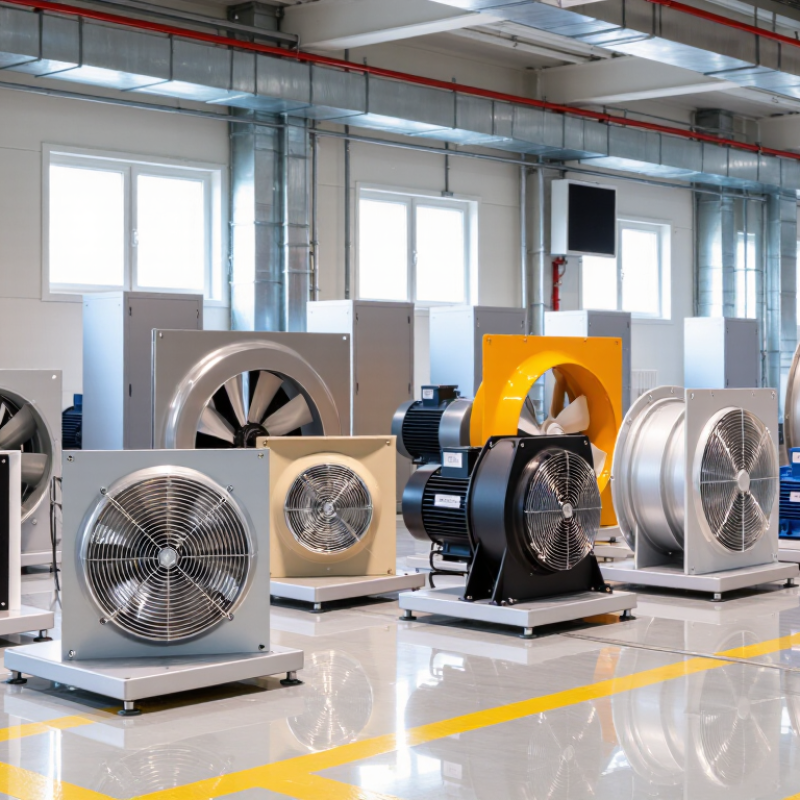
What Centrifugal Flow Fans Are and How They Work
A centrifugal flow fan draws air into the center of a rotating impeller, then pushes it outward through the blades. The air usually enters along the shaft and exits at an angle, often through a spiral-shaped housing called a volute. As the impeller spins, it adds energy to the moving air. The housing helps convert some of that velocity into usable pressure. That matters.
These fans can suit systems with ducts, filters, or other sources of resistance. Their performance depends on more than the fan itself: duct bends, dirty filters, and undersized openings can reduce airflow. A fan’s published curve shows how airflow changes as system pressure rises. Compare it with the expected operating conditions, not just the maximum airflow figure. That figure can be misleading without context. Noise, power demand, and mounting space also deserve attention.
Tips: Check the airflow direction arrows before installation. Leave room for service access, and keep the inlet clear. Recheck filter resistance over time; a clean-looking filter may still restrict airflow.
Key Factors for Evaluating Centrifugal Flow Fans
Selecting a centrifugal flow fan starts with the real duty point, not its headline airflow. Record required volume, static pressure, air temperature, and operating hours. Then compare the fan curve with the system curve; a mismatch can cause low flow, excess noise, or wasted power. The U.S. Department of Energy’s Improving Fan System Performance sourcebook estimates that fans use about 15% of the electricity consumed by motors in U.S. manufacturing. That makes efficiency worth checking at the expected operating point, not just at a catalog’s peak rating.
Tips: Ask for tested performance data and the test method. Check sound levels, motor efficiency, speed control, and access for cleaning. For dusty or warm air, verify materials and temperature limits against actual site conditions.
Installation can change results. A sharp bend close to the inlet, a restrictive guard, or a poorly sized duct may reduce delivered airflow. Compare total ownership costs, including energy, maintenance, and replacement parts, rather than purchase price alone. Ask suppliers to identify the fan’s stable operating range and provide the assumptions behind quoted figures. A neat catalog number can still mislead. Real sites are messier than test rooms, and some selection guides understate that gap. Check whether measurements reflect the installed arrangement before final approval.
10 Best Centrifugal Flow Fans for Global Buyers
Global buyers comparing the 10 best centrifugal flow fans should begin with duty point, not catalogue airflow. Match required volume flow and static pressure to the fan curve, then check efficiency near the expected operating range. Backward-curved impellers often suit efficient, steady-duty systems; radial designs can handle dustier air, while forward-curved models fit compact, lower-pressure applications. Actual performance depends on system resistance and installation.
That matters.
The International Energy Agency’s 2011 report, Energy-Efficiency Policy Opportunities for Electric Motor-Driven Systems, estimates that motor-driven systems use about 45% of global electricity. This figure covers many applications, not fans alone, but it explains why motor efficiency and controls deserve close review.
For cross-border purchasing, compare voltage, frequency, temperature limits, noise data, materials, and replacement-part availability. Request test conditions and certified performance curves; figures measured under different conditions may not be comparable. A tidy specification sheet can still miss real installation losses. Leave room for uncertainty, especially when ductwork or inlet conditions are not final.
How to Compare Fan Performance, Efficiency, and Reliability
When comparing centrifugal flow fans, start with the duty point: required airflow at the system’s static pressure. A fan rated for high volume may underperform once filters, ducts, and bends add resistance. Compare performance curves at the same conditions, not headline maximums. Check whether figures use clean air, a stated speed, and a defined test setup. Small details matter.
Tips: Request the fan curve, input power, and sound data at your operating point. Confirm how efficiency is reported. If a data sheet omits test conditions, compare cautiously; missing details can change the result.
Efficiency is not the only buying test. Match motor power and speed control to the expected load, then review vibration limits, bearing access, casing materials, and service intervals. For dusty or humid air, confirm suitability rather than assuming a standard unit will cope. Reliability claims need context. Ask for documented endurance results where available, and check spare-part lead times. I would not choose solely by the lowest energy figure; installation and maintenance affect real costs, too. Even careful comparisons leave some uncertainty before a site trial.
Centrifugal Fan Performance: The Effect of Speed
Compare relative airflow, pressure, and power across fan speeds. Values are indexed to a baseline speed of 100%.
Illustrative affinity-law estimates for the same fan geometry and air density: airflow varies with speed, pressure with speed squared, and power with speed cubed. Actual performance, efficiency, and reliability depend on the fan design and operating conditions; compare certified product curves and ratings when selecting a fan.
Global Buying Considerations: Standards, Shipping, and Support
For global buyers comparing centrifugal flow fans, a published airflow figure is only a starting point. Ask for performance curves tied to a stated test method, such as ISO 5801, and confirm the operating point against your system’s pressure loss. A fan selected near its limit may struggle after filters collect dust or ductwork changes. Small details matter: voltage, frequency, motor protection, coatings, and ambient temperature should match the installation site.
Shipping can change the real cost. UNCTAD’s Review of Maritime Transport reports that shipping carries over 80% of world trade by volume, but that does not make every delivery predictable. Confirm packaging dimensions, lifting points, corrosion protection, and required export documents before booking freight. Clarify who handles damage claims and whether replacement parts can ship separately. A wooden crate may arrive intact; the fan inside still needs inspection.
Support is part of the specification. Request installation guidance, wiring diagrams, balancing records, and a clear warranty process in writing. Check that service teams can work in your time zone and that common bearings or seals are available locally. ISO 14694 provides guidance on industrial fan balancing and vibration limits, useful when agreeing on acceptance checks. It is not a substitute for site measurements. That distinction is easy to miss. I would still ask how the supplier supports a fan after the first year; answers can be less precise than the sales drawings.

